
LIGHTWEIGHT TUBULAR STRUCTURES
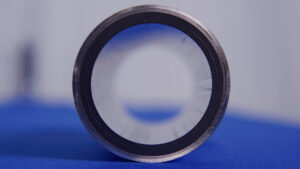
Techreo is a startup in Cincinnati, Ohio that has developed a novel tubular-structure construction that delivers large weight savings — in many cases roughly half the weight of comparable aluminum tubes. These tubes can replace structural tubing across a wide range of applications, and they are especially advantageous for robotic end-of-arm tooling (EOAT) and other dynamic systems where low mass improves performance.
Background – structural metal tubes are widely used for frames, machine components, scaffolding, sprayer booms, and similar applications. Typical materials are steel or aluminum; carbon-fiber composites are sometimes used for specialty needs. Techreo’s alternative composite construction combines different materials in the tube wall to provide capabilities and performance not achievable with homogeneous metal tubes or standard carbon-fiber tubes.
Weight matters. In static applications, heavier tubes require stronger, more expensive supports and are harder to handle, install, and modify. In dynamic applications, mass increases the force needed to accelerate components: F = m · a. Heavier tubes therefore require larger actuators and more energy to accelerate and decelerate.
Robotic EOAT example – tubes connect the payload to the robot wrist. Each robot joint has a maximum moment capacity (weight × distance). Heavy tooling consumes more of this capacity, reducing allowable payload and lowering the portion of robot power available for moving the payload. Heavier tooling also increases inertia, slowing cycle rates.
Common EOAT Materials
- Steel: Very strong with a high modulus of elasticity (low axial deflection) and high impact resistance (useful for surviving collisions). Drawback: high density (≈ 4.6oz/in³), making it the heaviest common EOAT material.
- Aluminum: About 1.6 oz/in³ (≈ one-third the density of steel) and relatively impact resistant. However, aluminum has roughly one-third the modulus of steel, so it deflects about three times as much.
- Carbon-fiber composite: Very low density (≈ 0.9 oz/in³) with high strength and excellent stiffness. Major drawback: brittleness — surface impacts can crack or permanently damage the tube, and repairs are usually not feasible; cost is also higher. Because of fragility and cost, many EOAT designers avoid carbon tubes for general-purpose tooling.
Techreo Tube Innovations – Techreo combines two key innovations to achieve large weight reductions: material substitution within the tube wall and stepped (tapered) tube assemblies.
- Material Substitution / Composite Wall Construction – Techreo tubes are built from the inside out using different materials in distinct wall regions. The composite arrangement yields higher performance than homogeneous metal tubing or conventional carbon-fiber tubes. Typical wall regions:
- Outer region: A continuous metal shell forms the exterior. For weight-sensitive applications, the shell is aluminum; for applications requiring greater axial stiffness or impact strength, stainless steel may be used. Both shells offer good impact resistance.
- Middle region: Multiple very thin metal layers are convolutely wound around the tube’s axis. These layers (aluminum or stainless steel) are bonded face-to-face
with a structural adhesive applied across the mating surfaces. The adhesive is very low density (≈ 0.6 oz/in³), which reduces overall tube density and provides excellent vibration damping because of the alternating metal/adhesive layers.
- Inner region: A discrete inner tube provides bulk stiffness and strength. For minimal weight, this is typically aluminum. Where axial stiffness or strength is critical, a carbon-fiber inner tube may be used. The outer and middle regions protect the carbon inner tube from impact, allowing use of carbon fiber without the brittleness issues that usually rule it out.
Structural adhesive bonds the inner and outer components to the middle-wound layers. Because the wall contains substantial volumes of low-density adhesive and/or carbon composite, Techreo tubes are intrinsically lower density than solid aluminum tubes. Typical Techreo base designs are 20–40% lighter than equivalent aluminum tubes.
- Stepped / Tapered Tube Assemblies – standard metal tubes are manufactured with a uniform cross section (constant outer diameter, inner diameter, and wall thickness) along their length. Techreo can produce tubes with stepped diameters— two or more axial sections with different outer/inner diameters — and join them with slip-fit overlaps bonded with adhesive. This reduces weight by tailoring outer diameter to the load distribution along the length.
Example: stepped tube assembly (total length 6.0 ft):
- Section 1 (adjacent to robot wrist): 2.4 ft long; OD = 3.0″, ID = 2.53″
- Section 2: 2.0 ft long; OD = 2.50″, ID = 2.0”
- Section 3: 1.6 ft long; OD = 2.0″, ID = 1.6″• Total length = 2.4 + 2.0 + 1.6 = 6.0 ft. Overlap regions between sections are sized for a slip fit (for example, ~4″ overlaps)and are adhesively bonded. A typical construction for each section might use an aluminum outer shell, wound aluminum middle layers with adhesive, and a carbon fiber inner tube. That assembly has an overall density near 1.0 oz/in³ and a total weight of about 8.3 lb for the 6 ft example.
For comparison, an industry-standard uniform aluminum tube with 3.0″ OD, 2.5″ ID, and6.0 ft length would weigh roughly 15.2 lb. The Techreo assembly in this example is therefore about 45% lighter — roughly half the weight of aluminum — demonstrating the combined benefit of the material substitution and stepped tube configuration.
Stepped assemblies also offer a standalone advantage: tapering the outer diameter along the length optimizes material use where less cross section is needed. In many cases a stepped profile yields an additional 10–20% weight reduction versus a uniform tube of the same maximum diameter. That 10–20% is in addition to the 20–40% weight savings typically gained from Techreo’s composite wall construction.
Manufacturing Flexibility – the stepped tube design is achieved by controlling the inner region tube dimensions and the thickness of the middle wound layers so adjacent sections can slip-fit and bond. This level of dimensional flexibility is difficult to achieve with standard metal tubing, which is commonly available only in fixed OD/ID/wall thickness combinations. While machining could create a slip fit, the cost is usually prohibitive. Techreo’s manufacturing method therefore enables weight-saving stepped designs that are not practical with conventional metal tubes.
Benefits – Techreo’s substantially lighter tubes provide several practical advantages:
- Lower actuation loads: Reduced mass requires less force to move. Supports and motion-control hardware can be smaller and less expensive; robotic systems have more available power to move payloads rather than accelerating tooling mass.
- Higher throughput: With more robot capacity available for payloads, systems can move heavier or more parts per cycle, improving productivity and lowering per part manufacturing costs.
- Capital avoidance: Lighter tooling can enable existing robots to handle new tasks without upgrading to larger robots, often saving much more than the tooling cost.
- Faster cycles and better ROI: Reduced inertia allows quicker acceleration and deceleration, increasing cycle rates and improving return on investment in high volume operations.
- Improved precision and reliability: Lighter tooling deflects and bounces less, enabling more precise positioning, fewer quality defects, and reduced jams, drops, and stoppages.
Conclusion – Techreo’s composite, stepped-tube approach combines low-density materials, vibration-damping adhesives, and tailored diameters along the tube length to deliver large, practical weight reductions versus standard aluminum and steel tubes. The result is a tubing solution that maintains impact resistance and stiffness where needed, protects brittle inner-carbon components, and significantly improves performance in dynamic and robotic applications.