
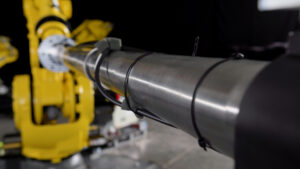
Redefining Robotic EOAT Performance through Advanced Composite Architecture
Techreo (Cincinnati, OH) has engineered a breakthrough in structural tube design, achieving 20–35% reductions in axial deflection compared to industry-standard aluminum. By utilizing a proprietary multi-material composite construction, Techreo tubes solve the critical challenge of precision and vibration in high-speed robotic and industrial applications.
The Problem: The High Cost of Deflection
In structural applications—from scaffolding to robotic End-of-Arm Tooling (EOAT) — deflection is more than a measurement; it is a failure point. Excessive deflection leads to:
- Positioning Errors: A windshield offset by 0.5″ cannot be installed, leading to
line stoppages. - Uncontrolled Vibration: Increased bounce forces slower cycle times to allow for
stabilization. - Mechanical Fatigue: Energy stored in a deflected beam accelerates cracking
in the tube and surrounding components.
The Techreo Innovation: A Holistic Design Strategy
Unlike homogeneous steel or aluminum tubes, Techreo employs a strategic “layer-cake” architecture to maximize the Specific Modulus (Stiffness-to-Weight ratio).
1. High-Modulus Hybrid Construction.
We leverage a synergistic blend of materials placed precisely where the physics demands them:
• Outer Shell: Aluminum () or Stainless Steel ().
• Core: High-modulus carbon fiber ().
• Bonding: A viscoelastic structural adhesive layer that accounts for 10–15% of
the wall volume.
2. Geometric Optimization ( Advantage)
Physics dictates that the moment of inertia () for a hollow tube is:
Techreo’s manufacturing process allows us to maximize the outer diameter () while
using low-mass carbon fiber and adhesives to maintain a thin, rigid wall. By spacing
high-modulus material further from the neutral axis, we drastically increase without the
weight penalty of solid metal.
3. Stepped and Overlapped Configurations
For extended EOAT reaches, Techreo utilizes a stepped-diameter design.
• Mass Efficiency: Larger diameters at the robot wrist (maximum stress) taper to smaller diameters at the tool end.
• Enhanced Overlap: Where tubes connect, the overlap creates a dual-wall region with a significantly higher effective modulus, eliminating the “weak link” common in traditional couplings.
Proven Performance Benefits
1. 25% Average Deflection Reduction
In head-to-head testing against standard aluminum tubes (2.50” OD / 2.0” ID) under a 30lb load at a 60” cantilever:
• Aluminum Deflection: 0.254”
• Techreo Average: 0.190” (25% improvement)
• Techreo Peak Performance: 0.175” (31% improvement)
2. Superior Specific Modulus
Weight is the enemy of robot payload capacity. Techreo tubes are 20–50% lighter than aluminum counterparts while maintaining higher stiffness. Our measured Specific Modulus (Modulus/Density) outperforms aluminum by 10% to 66%, allowing you to increase payload or use smaller, more cost-effective robots.
3. 3x to 50x Faster Vibration Damping
Through Constrained Layer Damping, our structural adhesive layer converts mechanical vibration into thermal energy.
• The Result: Techreo tubes dissipate “bounce” up to 50 times faster than
homogenous metal.
• The ROI: Shorter wait times for oscillation to settle means faster cycle times
and higher throughput.
Conclusion: Techreo isn’t just selling a tube; we are providing a high-performance mechanical
solution for precision-critical environments. By optimizing material placement, geometry,
and damping, we enable your robots to move faster, settle sooner, and place more
accurately.